
Community-led action planning for interrupting schistosomiasis transmission in Southern, Central and South West Ethiopia
Across rural Ethiopia, rivers, ponds, and irrigation canals are part of daily life. Communities rely on these water sources for washing, bathing, farming, and play. But these same waters can also carry invisible risks.
Schistosomiasis is a parasitic disease transmitted when people come into contact with freshwater where infected snails release parasites. Repeated exposure can lead to chronic illness and long term organ damage if left untreated.
Ethiopia carries one of the highest burdens of schistosomiasis in Africa, with tens of millions of people living in endemic areas. While treatment remains essential, lasting prevention depends on addressing the environmental and behavioral conditions that allow transmission to continue.
In January 2026, NALA, in close collaboration with district and zonal health offices to conduct a series of Community Action Plan workshops on vector control across Bench Sheko, West Omo, Hadiya, and South Omo zones, in South West, Central and South Ethiopia regions. These workshops marked an important step in translating snail mapping evidence into practical, community-driven action to reduce schistosomiasis transmission.
These workshops build on an approach pioneered by NALA in Ethiopia. Through structured snail mapping and training of community-based snail collectors, local teams systematically identify snail habitats and generate localized environmental data. This initiative introduces one of the country’s first coordinated efforts to directly link environmental surveillance with community-level schistosomiasis prevention planning.
Schistosomiasis transmission is closely linked to daily water contact and environmental conditions. Lasting disease prevention depends on how communities, local leaders, and government systems act on this knowledge and evidence together.
The workshops brought together a wide range of stakeholders, including Health Extension Workers, kebele administrators, community members, trained snail collectors, Technical Working Group members from health, water, education, and agriculture sectors, as well as woreda and zonal officials.
Participants reviewed recent snail mapping findings, which identified snail presence across multiple water contact sites and classified locations by risk level, providing a clear foundation for discussion and planning.
Rather than prescribing solutions, the workshops focused on collective analysis and local decision-making. Each kebele delegation developed a tailored action plan based on local water contact sites, risk levels, and community practices. Across districts, action plans emphasized feasible and low-cost interventions that communities can lead and sustain. These included vegetation clearance at high-risk water contact points, draining stagnant water, promotion of safer water access points, and targeted health education for children and adults.
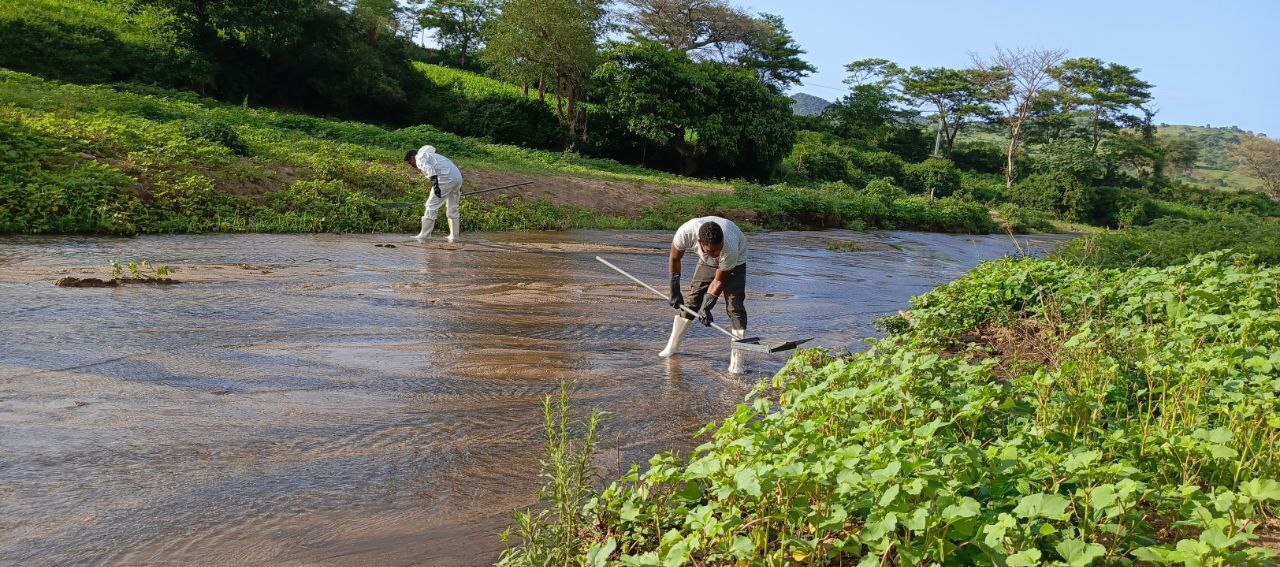
In several locations, community members immediately began field-based snail control activities along rivers and water points. Health Extension Workers, trained snail collectors, and nearby households worked together to clear vegetation and reduce snail habitats. Health education sessions accompanied these activities, reinforcing safer water contact practices, especially for children.
During field visits, community members reflected on how their understanding of disease prevention has changed.
“Before, children in our community often became sick from playing near the pond and small rivers. We were not motivated to clean these places. Now we understand the risk, and we are mobilized to clear them together. This is something we will continue in the future to protect our children.”
Zenebe Zewdu, farmer, Benatsemay Woreda.
Across all workshops, a strong sense of ownership emerged. Participants viewed snail control not as an external project, but as a shared responsibility within existing government systems and community life.
By aligning evidence, community planning, and coordinated action, these workshops strengthened the foundation for sustainable schistosomiasis prevention. They reflect a growing shift toward prevention focused health systems that are locally driven, evidence informed, and built to last.