
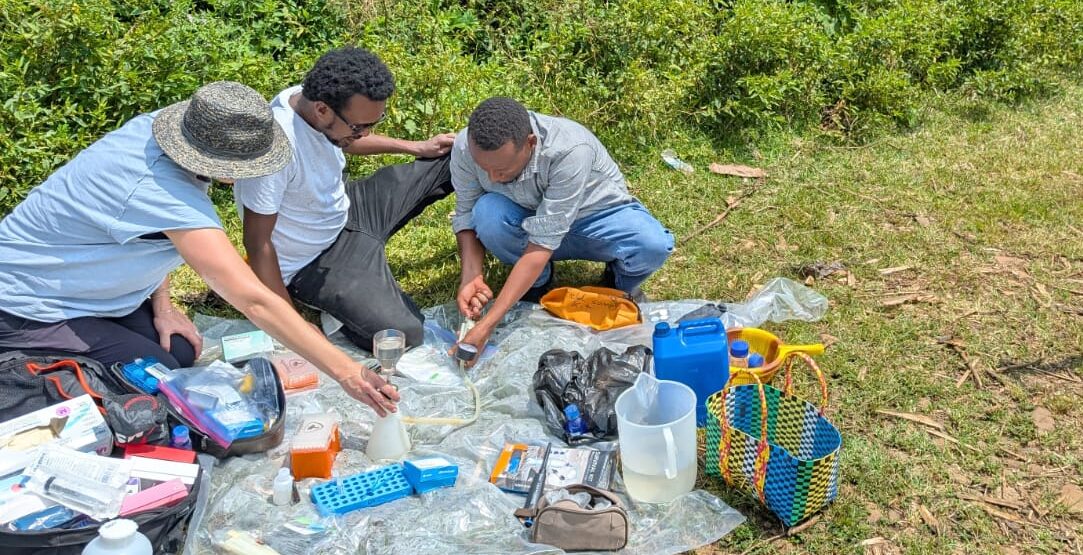
Our recent research trip to Ethiopia brought together NALA’s science team and partner researchers for a ten day journey through rivers, schools, and universities. The goal was simple and essential: understand the realities behind the data and strengthen collaboration with local researchers.
For Prof. Daniel Sher, a marine biology researcher from the University of Haifa, the trip was first and foremost a learning experience. It is one thing to talk about schistosomiasis from afar and another to stand at the river, see where water flows, how snails gather, how children interact with the water, and how nearby communities depend on it every day.
A school that shows the complexity of the challenge
One of the most powerful visits took place in Mizan Aman, where a school of three thousand students relies on contaminated water because there are few alternatives. This exposed how intertwined the issues are. River water, agricultural practices, sanitation, and school infrastructure all influence disease transmission.
Yet there was also hope. Children gathered around the team as Asrat Meleko, NALA’s regional project manager, carried out water sampling – and eagerly joined in. As they helped measure the water’s temperature and salinity, and collect samples for identification of potential pathogen DNA, they told us about their future aspirations (one wanting to be a cardiologist, another an architect). This reminded us that local engagement is already growing.
Research that responds to local needs
The trip highlighted how different diseases demand different approaches. The biggest lesson for Dr. Noa Dahan, who is heading NALA’s research department, was the importance of focusing on snail control for schistosomiasis using local materials and always involving communities. She also saw the enormous value of local wisdom, “Maybe it is how to make research as we know it fits into the place where we are visiting and not vice versa.”
It became clear to Asrat that environmental DNA and geospatial mapping hold great promise to strengthen Ethiopia’s surveillance system. Even with limited resources, these methods can help the Ministry of Health and partners target interventions more precisely.
Building interdisciplinary collaboration
Across visits to Jima, Mizan Tepi, and Addis Ababa universities, the team met researchers who brought deep knowledge and motivation. For Daniel, this reinforced the need for an interdisciplinary network, combining parasitology, public health, water quality, hydrology, education, and social sciences.
This collaboration is already producing strong data. The next step is to analyze it together and use it to guide practical decisions, such as where to place rainwater harvesting systems or which schools may benefit from WASH on Wheels.
For our supporters, this trip shows what your partnership makes possible. You help bring together science, local experience, and community leadership to create prevention solutions that last.