
By Ella Tairy, Public Health Intern at NALA
In 2023 in Adwa, a town in northern Ethiopia, a water point stood broken. Children continued walking long distances for water. Hands went unwashed before meals. And in the health facility nearby, staff struggled to maintain basic hygiene standards without reliable access to water. It is the kind of situation that rarely makes headlines, but plays out in communities across the world every day, its consequences quietly devastating.
If we looked at Adwa five years earlier however, we’d see a very different picture. In 2015, NALA implemented a four year holistic program combining water, sanitation and hygiene (WASH) support with social and behaviour change, driving intestinal parasite infections among schoolchildren from 26% down to just 1.5%. Children were washing their hands. Latrines were functioning. The numbers told a story of real, measurable progress.
So what happened?
First came COVID-19, disrupting the planned program transition. Then, in late 2020, conflict erupted across the Tigray region. Schools closed or became displacement centres. Water and sanitation systems were damaged or abandoned. For nearly two years, many schools had little to no reliable access to clean water. Hygiene practices deteriorated as resources disappeared and communities were uprooted.
When NALA returned to re-assess conditions in 2023, the scale of the reversal was stark. Intestinal parasite infections had surged to 32.8% – even higher than when the program had started nearly a decade earlier. More than 80% of schools showed evidence of open defecation. Latrines were unsafe or unusable. The infrastructure that had taken years to build and embed into daily school life had collapsed.
Adwa is an extreme case, but it illustrates a pattern of hard-won WASH gains lost when systems are not resilient enough to withstand disruption. Access to WASH is one of the most powerful tools we have in public health. Diarrhoeal diseases alone kill nearly half a million children under five each year – the vast majority preventable through improved water and sanitation (1). Diseases like trachoma, the world’s leading infectious cause of blindness, are directly linked to insufficient facial hygiene and poor environmental conditions. The science is clear: when WASH works, children live longer and healthier lives, giving them the opportunity to learn and thrive.
So why aren’t we doing it better?
We’re better at building than maintaining
The honest answer is that thus far, global health has shown more interest in funding infrastructure than in sustaining it. A new water point is visible, quantifiable, and photographable.The true successes, however, are the water points that are still functioning three years later, steadfastly maintained by trained local technicians who have taken the health of their communities into their own hands.
This bias towards construction over continuity has real consequences. Studies suggest that a significant proportion of WASH facilities in low-income settings become non-functional within just a few years of installation (2). Infrastructure gets counted at the moment it is built, not monitored years later. Coverage targets are met on paper while taps run dry in practice.
In Adwa, the breakdown wasn’t a surprise. It was the predictable result of a system built without the necessary maintenance, oversight, and local technical capacity needed to keep it running – particularly in a setting affected by political instability and limited follow-up from implementing partners. The facility had been installed, but no one had planned for what came next.
When systems are built to last
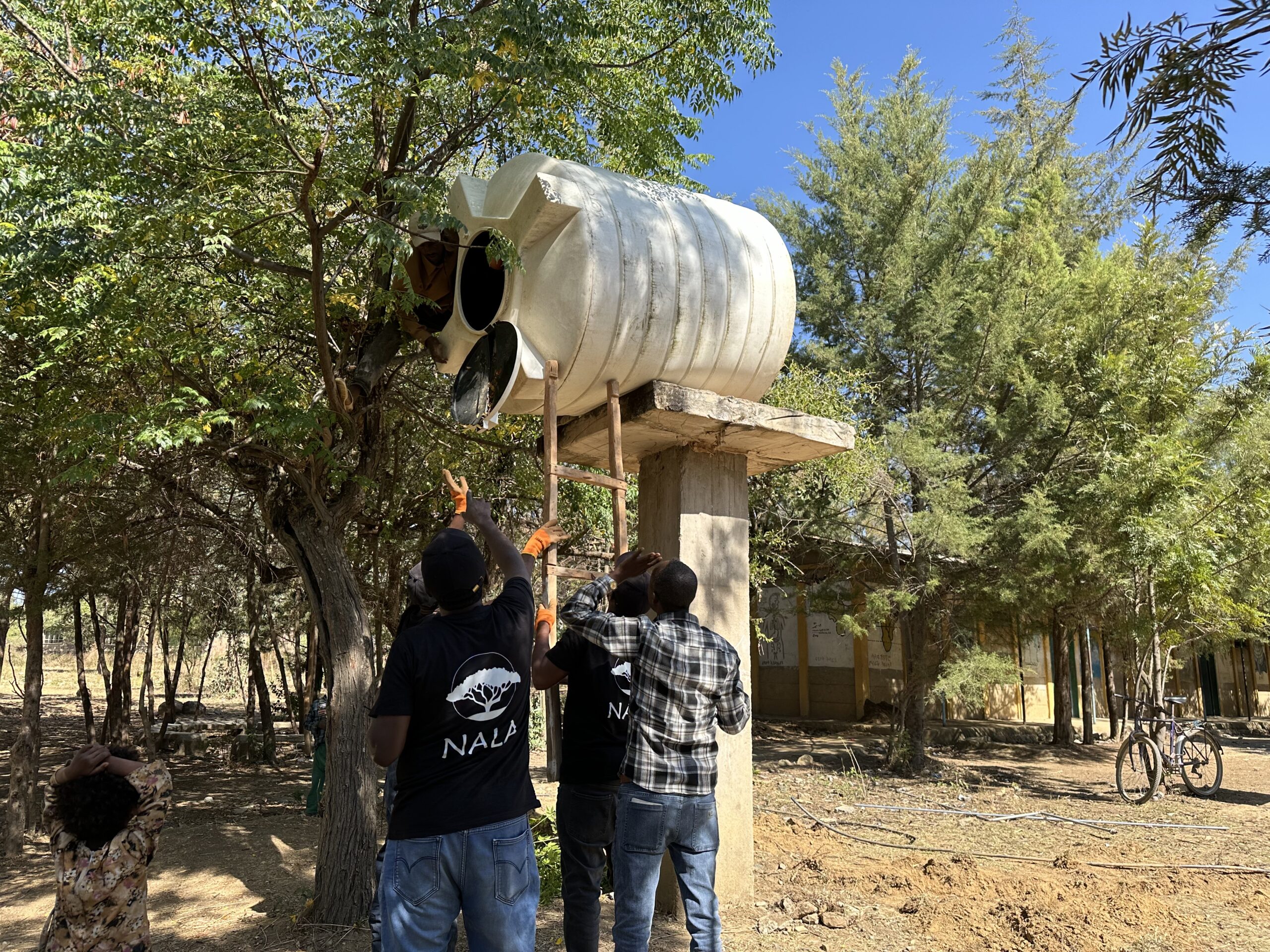
This is the challenge that NALA’s WASH on Wheels (WOW) project set out to address in Ethiopia. Rather than focusing on new construction, WOW centred its approach on something less glamorous but more durable: keeping existing school WASH facilities functional through mobile maintenance services, trained local personnel and systematic monitoring.
Across five regions of Ethiopia, the project supported 374 school WASH facilities, benefiting more than 256,000 students and staff. Crucially, it also invested in the surrounding systems. Local WASH Fellows were trained to support ongoing maintenance, and coordination with district-level stakeholders helped embed accountability into the process.
The results speak to the value of this approach. A recent functionality assessment found that WOW-supported facilities maintained a two-year sustainability rate in Adwa of around 90% compared to a national average of approximately 65% (3). Facilities didn’t just get fixed. They stayed fixed, and the difference came down to whether maintenance systems, monitoring mechanisms, and local technical support remained in place after the initial intervention ended.
A different measure of success
The Adwa story carries a broader lesson for how WASH programs are designed and evaluated. Infrastructure alone is rarely enough. What determines whether a facility is still working two years after installation is not the quality of the original construction, it is the presence of systems capable of responding when inevitable breakdowns occur.
This matters particularly within efforts to eliminate neglected tropical diseases. programs targeting soil-transmitted helminths (STH), schistosomiasis, trachoma, and similar diseases often focus on treatment with minimal to no prevention components. While national and international frameworks promote an integrated approach that includes behaviour change and WASH components, real-life implementation has lacked consistency, contextualization, and sustainability. For prevention, the environmental component only delivers when water points work, latrines are safe, and handwashing facilities are stocked and functional.
Sustainable access to water and sanitation is not achieved through installation alone. It depends on local capacity, governance, financing, and long-term community engagement. These are less visible than the infrastructure itself, but they are what determine whether services remain usable months and years down the line.
As global health programs increasingly emphasise systems strengthening and long-term impact, sustainable WASH investment needs to follow. The question is not only how many facilities are built, but how many are still working, and what it takes to keep them that way.
References
- https://www.who.int/news-room/fact-sheets/detail/diarrhoeal-disease
- https://gh.bmj.com/content/10/2/e016354
- Nala: A Functionality Assessment of School WASH Facilities Maintained under the WASH on Wheels (WOW) Project in Ethiopia